How Palm Oil Mill Machinery Works?
Palm oil is the most widely produced vegetable oil globally; Palm oil processing—from fresh fruit bunches (FFB) to finished oil—relies on a sophisticated, integrated mechanical system. Understanding the working principles of palm oil mill machinery is essential not only for equipment selection and process optimization but also for controlling oil extraction rates and product quality. This article uses the palm oil production line from Henan Huatai Cereals & Oils Machinery Co., Ltd. as a case study to systematically analyze the core operational principles of a palm oil mill.
Overall Process Flow of Palm Oil Mill Machinery
Palm oil processing is essentially a combination of physical separation and refining/purification. The oil within fresh fruit bunches exists primarily as intracellular lipid bodies; the primary task of the machinery is to disrupt cellular structures through physical means—such as sterilization, threshing, digestion, and pressing—to release the oil from the pulp. Subsequently, clarification, refining, and fractionation processes are employed to yield finished oil that meets industry standards.
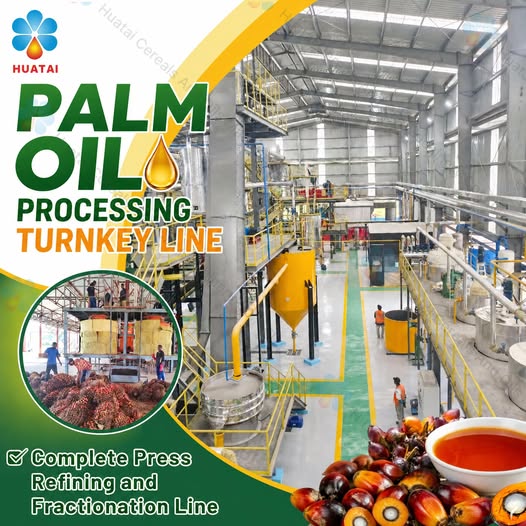
The palm oil production lines provided by Huatai Oil Machinery cover capacities ranging from 10 to 1,000 tons per day. The complete process comprises three main stages: the extraction stage (from FFB to crude oil), the refining stage (from crude oil to refined oil), and the fractionation stage (from refined oil to products with varying melting points).
Palm Oil Extraction Stage: From Fresh Fruit Bunches to Crude Palm Oil
Extraction is the core stage of the palm oil mill, directly determining the oil yield and the quality of the crude oil. The palm oil extraction equipment from Huatai Oil Machinery encompasses the following key steps:
1) Sterilization: Enzyme Inactivation and “Heat Treatment” to Loosen Fruit
Fresh fruit bunches must be transported to the palm oil extraction plant within 24 hours of harvesting; otherwise, free fatty acid (FFA) levels rise rapidly, compromising oil quality. The sterilization process treats the fruit bunches with high-temperature steam (approximately 150°C for two hours) to achieve two objectives: inactivating lipase activity to prevent oil rancidity, and softening the fruit bunch stalks to facilitate the detachment of individual fruitlets from the bunch. The sterilization tanks customized by Huatai Oil Machinery for overseas clients boast a processing capacity of up to 30 tons per hour and have already been deployed in projects in regions such as Cameroon, Africa.
2) Fruit Threshing: Vibratory separation of fruitlets and empty fruit bunches
After sterilization, the fruit bunches are conveyed via a bucket elevator to the thresher, where intense vibration separates the palm fruitlets from the empty fruit bunches. The empty bunches are typically utilized as fuel or fertilizer, while the fruitlets proceed to the next stage.
3) Digesting and Pressing: Breaking down cells to extract oil
The fruitlets undergo high-temperature cooking to further disrupt the pulp cell structure, facilitating oil extraction. They then enter the palm fruit oil press—the core equipment of the primary extraction stage. Huatai Oil Machinery’s proprietary “Twin-Screw Palm Fruit Oil Press” features a fully automated PLC control system and an IoT module for real-time production parameter monitoring and remote maintenance; it delivers excellent oil yield and significantly lower energy consumption compared to traditional palm oil equipment.
4) Crude Oil Clarification: Solid-liquid separation
The liquid mixture resulting from pressing requires clarification. Typically, hot water is used to reduce the crude oil’s viscosity, and vibrating screens remove solid impurities. The oil is then heated to 85–90°C and separated in a clarification tank, yielding crude palm oil that is sent to storage tanks.
5) Palm Kernel Recovery: Secondary utilization of press cake
The press cake produced during extraction is a mixture of fibers and palm kernels. After passing through a fiber separation system, the palm kernels are sent to a dedicated silo for subsequent palm kernel oil extraction. Palm kernel oil is highly valuable. Its processing requires specialized equipment for separating kernels from shells and for pressing; because palm nut shells are exceptionally hard, pressing them without prior separation would cause severe equipment wear.
Palm Oil Refining Section: From Crude Oil to Finished Product
Crude palm oil contains free fatty acids, pigments, metal ions, and odor-causing substances; it must undergo refining to become food-grade oil. Huatai Oil Machinery offers three refining solutions: batch (suitable for small 1–20 TPD lines), semi-continuous (suitable for medium-to-large 20–50 TPD lines), and fully continuous (suitable for large 50–600 TPD oil plants).
Key palm oil refining steps include:
Degumming/Deacidification: Using a washing method to separate soap stock from the oil mixture and reduce free fatty acid content;
Bleaching: Removing pigments, residual soap, and metal ions to improve the oil’s color;
Deodorization: Removing unpleasant odors under high-temperature and high-vacuum conditions to produce edible oil with a pure flavor.
Taking a client project in the Democratic Republic of the Congo as an example, the 100 TPD palm oil refining line delivered by Huatai Oil Machinery utilizes proprietary core equipment. It employs an intelligent system to achieve smart control over equipment, production, and management, ensuring that product quality and low-carbon emission standards reach world-class levels.
Palm Oil Fractionation Section: The Key to Maximizing Value
Palm oil possesses unique multi-melting-point characteristics—a key feature distinguishing it from other vegetable oils. Through fractionation, refined palm oil can be separated into products with different melting points (such as soft oil, medium-fraction oil, and stearin), significantly enhancing economic value.
The three main stages of fractionation are:
Heating: Heating the refined oil to approximately 60°C to ensure complete liquefaction;
Cooling and Crystallization: Precisely controlled cooling to allow high-melting-point solid fats to precipitate as crystals;
Membrane Filtration: Using membrane filters to efficiently separate the solid and liquid fractions.
Huatai Oil Machinery’s palm oil fractionation lines offer processing capacities ranging from 1 to 500 TPD and feature precise automatic temperature control software, ensuring stable and reliable fractionation results.
Technical Support from Huatai Oil Machinery
Realizing the aforementioned operating principles relies heavily on the technical expertise accumulated by the manufacturing enterprise. Established in 1988, Henan Huatai Cereals & Oils Machinery Co., Ltd. is recognized as a national-level “Little Giant” enterprise (specializing in niche markets with cutting-edge technologies) and a national-level “Green Factory.”
In the field of palm oil machinery, Huatai possesses numerous patented technologies. Its complete sets of palm oil processing equipment integrate multiple patents covering pressing, refining, and fractionation, enabling the machinery to meet the specific production requirements of major producing regions across Southeast Asia and Africa.
Market performance demonstrates the company’s success: Huatai’s palm oil equipment has been exported to over 70 countries and regions worldwide, with multiple palm oil refining projects successfully delivered in locations such as the Democratic Republic of the Congo and Cameroon.
Summary:
The core operating principle of a palm oil mill plant involves extracting high-quality oil efficiently from fresh fruit bunches through a continuous physical processing chain: sterilization and enzyme deactivation, fruit threshing and separation, digesting, screw pressing, clarification and refining, and fractionation. As a leading enterprise in the grain and oil machinery sector, Huatai distinguishes its palm oil production lines through advanced automation, optimized energy consumption, and adaptability to overseas environments, thereby providing a concrete engineering example that illustrates these operating principles.
Website: https://palmoilmachine.com/
Email: info06@cnoilmachine.com


