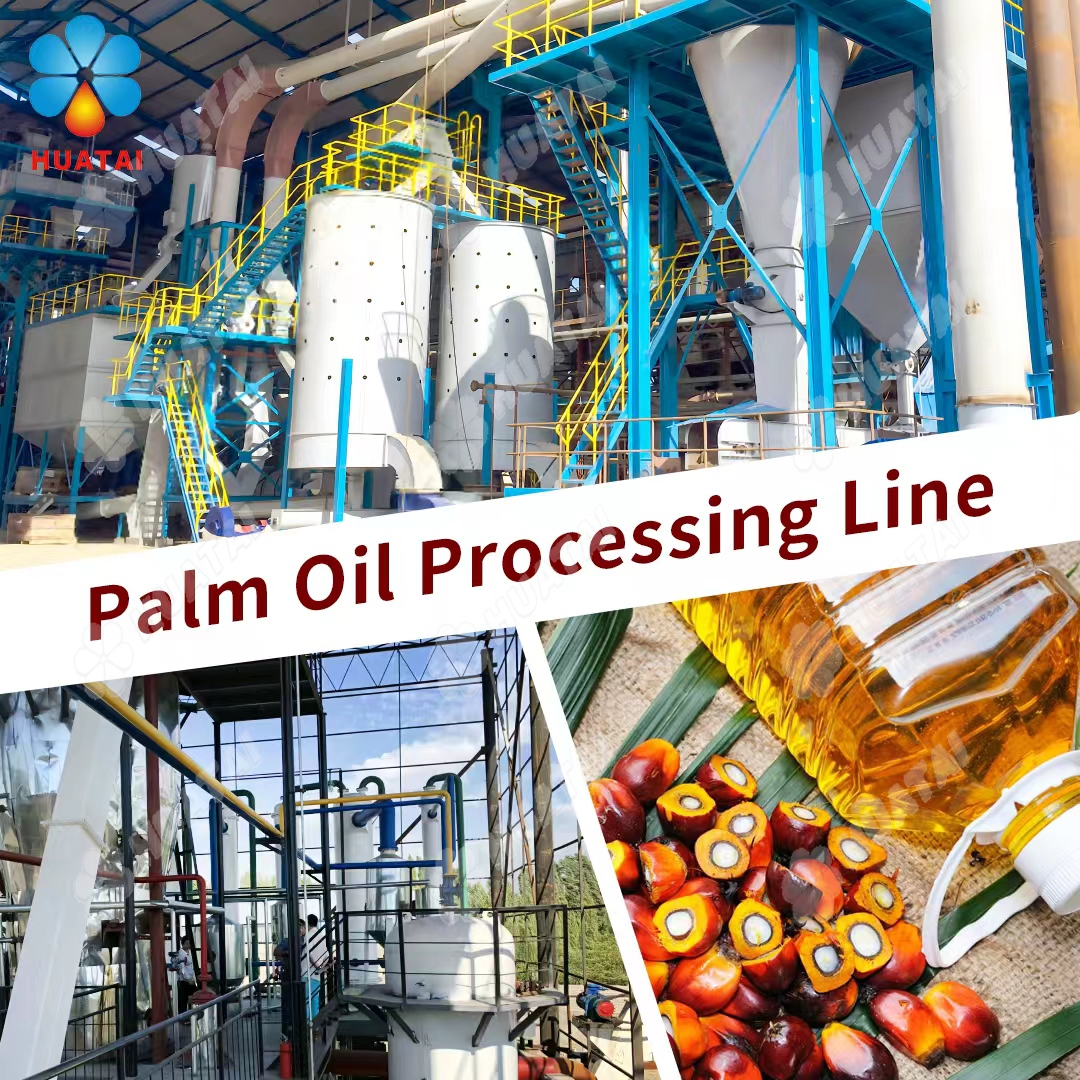
How Many Tons of Palm Fruit Are Required to Produce 1 Ton of Palm Oil?
In the palm oil processing industry, one core question consistently garners significant attention: How many tons of palm fruit are required to produce 1 ton of palm oil? The answer to this question directly impacts production costs, equipment selection, and overall economic efficiency. As one of China’s leading manufacturers of edible oil and fat machinery, Henan Huatai Cereals and Oils Machinery Co., Ltd. draws upon 38+ years of industry experience to provide you with a detailed analysis of this critical metric, while also sharing insights on how to enhance oil extraction efficiency through the use of advanced palm oil equipment.
The Standard Answer: How Many Tons of Palm Fruit Are Needed for 1 Ton of Palm Oil?
According to general industry standards and actual production data from Henan Huatai Cereals and Oils Machinery Co., Ltd., producing 1 ton of Crude Palm Oil (CPO) requires approximately 2.5 to 3 tons of Fresh Fruit Bunches (FFB). The specific figure depends on the following factors:
1) Palm Fruit Variety: Different varieties exhibit significant differences in oil extraction rates; high-quality varieties can yield 0.22 to 0.25 tons of oil per ton of fruit bunches.
2) Fruit Maturity: Fully mature palm fruit yields the highest oil extraction rate, whereas immature or overripe fruit results in reduced oil output.
3) Processing Technology: Traditional palm oil pressing methods yield lower extraction rates, whereas the adoption of modern equipment (such as Henan Huatai’s hydraulic presses and screw presses) can boost the extraction rate to between 20% and 24%.
4) Equipment Performance: Highly efficient sterilization, threshing, and pressing equipment can maximize the extraction of oil from the fruit pulp.
Calculation Formula:
Palm Fruit Requirement (tons) = 1 Ton of Palm Oil ÷ Oil Extraction Rate (%)
For example: With an oil extraction rate of 20%, 5 tons of fruit bunches are required; with a rate of 24%, only 4.17 tons are needed. However, in actual production—due to the presence of impurities and moisture within the fruit bunches—an industry empirical value of 2.5 to 3 tons is typically used.
The 5 Key Factors Influencing Palm Fruit Oil Extraction Rates
1) Fruit Processing Efficiency
The journey from fresh fruit bunches to the palm fruit pressing stage involves a series of processes, including sterilization, threshing, digestion, and pressing. Henan Huatai Cereals and Oils Machinery Co., Ltd.’s continuous sterilizers and double-screw oil presses can significantly minimize pulp loss, thereby boosting the oil extraction rate by 2% to 5%.
2) Degree of Equipment Automation
Manual operations are prone to causing raw material wastage. Fully automated palm oil production lines—such as Huatai’s complete set of PLC-controlled palm oil equipment—allow for precise control over temperature, pressure, and processing time, ensuring an additional yield of 10–15 kilograms of oil per ton of palm fruit bunches processed.
3) Palm Kernel Separation Technology
While palm kernels have a low oil content, residual pulp adhering to them can lead to wastage. Huatai’s vertical hydrocyclone separator achieves a kernel-pulp separation rate of 99%, thereby preventing the loss of valuable oil.
4) Pressing Pressure and Temperature
High-pressure, low-temperature pressing techniques help preserve the active components within the oil while simultaneously boosting oil yield. Huatai’s hydraulic oil presses operate at pressures reaching 55 MPa, extracting 3%–6% more oil compared to traditional equipment.
5) Wastewater and Residue Utilization
High-quality equipment enables the recovery of residual oil from pressing wastewater. Henan Huatai’s three-phase centrifugal separators can extract an additional 0.5%–1% of oil from wastewater, effectively transforming waste into valuable resources.
Henan Huatai Cereals and Oils Machinery Co., Ltd.: How Can We Help You Reduce Palm Fruit Consumption?
As a high-tech enterprise, Henan Huatai Cereals and Oils Machinery Co., Ltd. offers a comprehensive range of palm oil processing equipment with capacities ranging from 10 to 1000 tons/day, helping clients achieve the following results:
1) Increase the oil extraction rate per ton of palm fruit bunches to 22%–24% (compared to the industry average of approximately 18%–20%).
2) Produce one ton of palm oil using only 2.3–2.7 tons of fruit bunches, saving 10% on raw materials compared to traditional processing methods.
3) Reduce processing energy consumption by 15%–20% through the implementation of waste heat recovery systems and energy-efficient motors.
Key Advantages of Our Core Equipment:
1) Twin-Screw Palm Fruit Oil Press: Features a patented spiral structure that integrates crushing and pressing functions, boosting oil extraction efficiency by 18%.
2) Vertical Sterilizer: Ensures uniform steam heating for thorough softening of the palm pulp, resulting in a loss rate of less than 0.5% prior to pressing.
3) Palm Kernel Separation System: Utilizes a multi-stage screening and gravity separation process to ensure that the residual pulp content adhering to the kernels remains below 1%.
Summary: How to Choose an Efficient Palm Oil Processing Solution?
The quantity of palm fruit required to produce 1 ton of palm oil serves, fundamentally, as a benchmark for evaluating the efficiency of equipment and processing techniques. Henan Huatai Cereals and Oils Machinery Co., Ltd. offers the following recommendations:
1) Prioritize fully automated palm oil pressing equipment designed for low residual oil content.
2) Incorporate auxiliary systems, such as kernel separation and oil recovery from wastewater.
3) Require the manufacturer to provide a guaranteed commitment regarding oil extraction yield.
Contact us today to receive your personalized palm oil processing solution! Based on the specific characteristics of your raw materials and your production capacity requirements, we will custom-design a highly efficient palm oil extraction production line to help you maximize the value derived from every ton of palm fruit.
Website: https://palmoilmachine.com/
Email: info06@cnoilmachine.com


